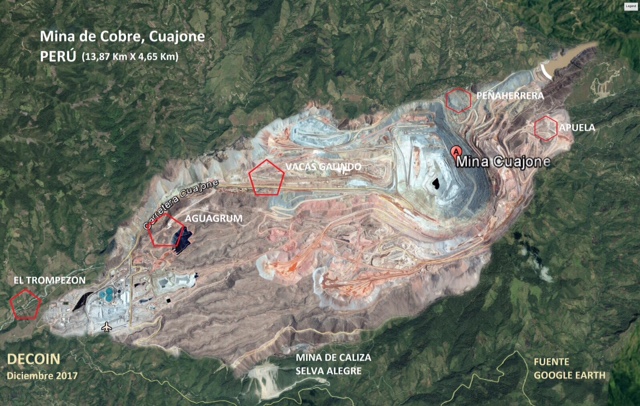
GOOGLE TRANSLATION: there are places where the translation is not perfect, but the article itself is a good testimony to the destructive nature of mining. This article was forwarded to me by my friend David, who among many others would be greatly affected by the decision to have a mine opened here in the Intag Valley. Following this article from planv.com.ec, there is a photo sent from David who received it from another friend showing the possible proposed sight for an additional mine here.
The Mirador Mining project has harmful effects on the health of ecosystems and the population. This is one of the main conclusions of the study “The Mined Field of Health”, by María Paola Granizo Riquetti and published this year by the Platform for the Right to Health.
See the full report on health effects in the Mirador Project. See the PDF here
The study, which analyzes open-pit mega-mining in the southern Amazon of Ecuador and its impacts on health, takes into account several aspects related to the local ecosystem and also to the health of the inhabitants of the area.
“The present study is of qualitative descriptive nature; it is based on literary review, field visits and collection of testimonies of inhabitants, health personnel and workers and former workers of ECSA and other companies of various kinds (transport, infrastructure). It aims to make visible and report the effects of the installation of the first large-scale, open-pit mine in the country on the health in Tundayme, its inhabitants, the community and ecosystems. It aims to enrich the debate around the imposed economic model, strengthen the resistance processes and contribute with an input for the fight for the defense of the territories “, anticipates the author.
The Mirador mining project is a large copper mine located in the southern tip of the country, which is operated by a Chinese company. The mining company, which was recently inaugurated, exploits the copper-rich land in the area and creates a sludge that is exported out of the country by sea to copper processing plants abroad.
The researcher makes a compilation of the main effects caused by the mining operation in the sector.
According to the researcher, psychosocial impacts are evident and there are also physiological conditions.
Among his conclusions, he emphasizes that “the installation of the Mirador project has implied the destruction of biodiversity in an irreparable and irreversible way, since deforestation is the main cause of alteration of ecosystems. The loss of forests directly influences the wealth and abundance of species, “says Rizotti Hail.
More than 1300 hectares deforested
Stresses that for the construction of the Mirador Project “it was necessary to deforest 1,300 hectares of forest between 2009 and 2017, according to satellite images of the Amazonian Andes Monitoring Project. This intervention is moderate if compared with the 9,000 hectares contemplated by the The works continue until the sufficient material is removed to open an open pit of approximately 1 km deep and 1.5 km in diameter, from which 60,000 tons of material will be extracted daily, less than 2% of that amount ( 1,000 tons) will be exported in the form of a copper concentrate; the rest of the material, that is 98% (about 58,800 tons), will probably be acidic and high-content mining wastes (as evidenced elsewhere ) stored in tailings pools, approximately 47,000 tons of waste corresponding to sterile rock should be added to this amount. Olives produced each day will amount to approximately 107,000 tons (average amount equivalent to two months of domestic waste from the city of Quito). Two tailings pools have also been built, whose total storage capacity will be 491 million cubic meters. “
First, the researcher points out that “the Mirador project has caused the loss of local livelihoods, contributes to unemployment and the loss of labor for economic activities alternative to extractivism.” Based on a field investigation, the author points out that “The change in the ways of life of the community has affected her organization. The testimonies speak of times in which cordial relations were enjoyed; now mistrust and insidia prevail. Psychosocial involvement of the inhabitants was expressed during the interviews: people cry or fall silent, keep their eyes lost or suffer absences. Social organization and cohesion have varied ostensibly after the mining incursion. “
Is pollution controlled?
On the other hand, and despite the mining company’s announcements about measures to prevent pollution, the researcher says that “the pollution of the river has caused the local disappearance of fish and has restricted access to protein sources of many families” of The inhabitants of the sector.
Another impact that the study has been able to determine is that “the dietary habits of families have changed from a balanced diet, rich in fiber and protein, to a diet based on carbohydrates and fats,” which he attributes to the arrival of the company Mining to the area.
ANOTHER IMPACT THAT THE STUDY HAS BEEN ABLE TO DETERMINE CONSISTS THAT “THE FAMILY FOOD HABITS HAVE CHANGED FROM A BALANCED DIET, RICH IN FIBERS AND PROTEINS, TO A DIET BASED ON CARBOHYDRATES AND FATS”, WHICH DETERMINES IT TO THE MINING TO THE AREA.
For the author, in addition, “mining promotes corruption and deteriorates public ethics,” while estimating that “the implementation and development of mining projects require the violation and systematic violation of rights and legal norms: individual rights, collective, labor and nature. “
For Granizo, “the Mirador project erodes the health practices of the indigenous population, prevents their access to widely used and commercialized medicinal plants, such as dragon’s blood”, while in the nearby Tundayme population, “violence, alcoholism and drug addiction have increased considerably. “
In the case of dragon’s blood, the author reports that “Dragon’s blood is a species of national renown that is used to treat some health conditions. In Tundayme, its distribution is restricted to the area where the company was installed. mining, so that access to this resource is blocked for communities. In this sense, one might ask, how many plant species are no longer available to people? “he asks. “The emission of dust, product of the permanent circulation of dump trucks and large capacity vehicles, affects the orchards of the mestizo communities that are closer or on the road that leads to the mining facilities. Due to this dust people already they cannot have natural remedies, “adds the researcher, based on testimonies from the residents of the area.
On the plants that the inhabitants of the sector use, the study states that “Shuar communities have extensive knowledge about the use of plants for various purposes: medicinal, food, spiritual, culinary, to fish and hunt animals. They are cultivated in their aja or Orchards: guayusa, cinnamon, ayahuasca, cocoa, cane, sweet potato, chives, dulcamara, lemon, malicahua, quince, papachina, banana, pelma, papaya, pineapple shuar, pore, rolaquimba, rue, tobacco, verbena, corn, yucca, squash , chili, cotton, carrot, piripiri, escancel, wirin, barbasco, peanut, beans, ginger, yerba luisa, mint, basil, tuka, spinach, namuka, yours, namau and tapir. “
The researcher also argues that “women and girls are particularly affected by the implementation of the Mirador project; they are victims of harassment and rape.”
Regarding the situation of the mining company, the author argues that “this year’s Comptroller’s report should be sufficient reason to cancel the Mirador project concession (as well as the other strategic mining projects)”, although the current Government is against that possibility.
The author, based on her analysis of the problem in the area, makes some recommendations. Among these, that the Ministry of Environment “should make transparent the information generated from the environmental monitoring it performs”. The State should also “conduct information campaigns on the dangers of mining on comprehensive community health,” while “non-governmental organizations could generate much stronger and more critical strategies around extractivism in general and mining in particular. They should review key documents, such as the National Mining Development Plan, or the accountability reports of government entities, to create more effective tactics on the fronts of struggle, providing a technical analysis to their networks and, in turn, informing the communities about the effects generated by mega-mining “.
Some recommendations
Hail also maintains that it is necessary “to promote a national debate with all the social organizations, groups and associations of defense of the territories around the governance and the political instruments used up to now, and to evaluate them critically”.
“The Mirador mining project should be suspended referring to the precautionary principle,” he says.
“THE MIRADOR MINING PROJECT SHOULD BE SUSPENDED BY ALLOWING THE PRECAUTIONARY PRINCIPLE,” THE AUTHOR INSURANCES IN THE CONCLUSIONS OF HIS STUDY.
Among the figures that the author contributes to the debate are the animal and plant species that were identified in the environmental impact study of the Mirador project: 142 species of flora; Of these, 11 are endemic, 4 species are almost threatened, 4 are vulnerable and 2 are endangered, as well as 25 species of mammals: monkey, armadillo, squirrel, porcupine, guanta, guatusa, otter, ocelot, yaguarundi, puma, cuchucho, mountain dog, anteater, peccary, deer, danta and bat. Of these, the danta is in the vulnerable category, the peccary, the mountain dog, the macho monkey and the pennant anteater are almost threatened. In the area there are also 51 species of birds; of these, 4 are endemic, 6 are under the almost threatened category and 6 are vulnerable. It also highlights the presence of 109 species of herpetofauna, of which 5 are endangered and 20 species of fish.
Below are articles found as I searched for more information about what is happening in South America. While many would argue about the jobs created with the introduction of mining, one must look past the initial date of start-up to the plan down the road. The jobs are temporary, heavy equipment is brought in to do the work of men, so really, we must stop fooling ourselves into believing these companies have the best interest of the people in mind when they come here.
- BUENOS AIRES (Reuters) – Argentina’s president-elect Alberto Fernandez vowed on Monday to ‘turn the page’ on the IMF-backed policies of incumbent Mauricio Macri, after voters weary of rising poverty and inflation swept the left back to power in Latin America’ No.3 economy. Argentina’s President Mauricio Macri waves as he arrives for a meeting with President-elect Alberto Fernandez at the presidential palace Casa Rosada, after Fernandez won in the presidential elections, in Buenos Aires, Argentina October 28, 2019. REUTERS/Agustin Marcarian
Argentina’s electorate voted overwhelmingly on Sunday to ditch the economic liberalization and austerity of conservative Macri, which has left the commodities-rich nation teetering on the brink of a $100 billion debt restructuring, and turned instead towards the Peronist left.
The two leaders held brief talks on Monday about a transition of power, with Fernandez vowing to take the country of over 44 million people in a vastly new direction to the business-friendly reform agenda espoused by his predecessor, a staid former magnate with close ties with the United States.
“We began to turn the page today. This page (of Macri) will be forgotten and we will start writing another story on December 10 when we arrive with Cristina in government,” Fernandez said after his election win, referring to his divisive running mate Cristina Fernandez de Kirchner.
The return of the Peronists, and populist ex-president Fernandez de Kirchner, has startled some in Argentina and beyond, concerned that reforms to open Argentina more to global markets could be undone.
RELATED COVERAGE
- Mexican president to congratulate Argentina’s Fernandez, Bolivia’s Morales
- Left’s win in Argentina strains Brazil ties, deepens regional divide
Markets on Monday were mixed, still uncertain how to respond to the result with many questions unclear.
Argentina’s central bank moved swiftly in the early hours of Monday to tighten capital controls during the transition and the peso closed 0.65% stronger.
In the parallel black market, the local currency was more volatile, having fallen as low as 77 to the dollar, while Argentine over-the-counter bonds dipped 1.6% on average.
How Macri and Fernandez work together over the next few weeks will be key. With talks looming with creditors over $100 billion in debts, reserves are dwindling, inflation is sky-high and rising poverty is sparking anger.
“I’m worried because I already went through Cristina’s government and it was very hard for farmers,” said Sergio Storti, 58, a grains and cattle farmer in the bread basket province of Buenos Aires.
Markets are watching closely to see where Fernandez, a dark horse candidate who was a relative unknown until earlier this year, stands on key policies that could impact the peso, which crashed in August after he secured a landslide win in a primary vote.
In a bid to soothe markets, Fernandez and Macri signaled with their meeting on Monday that they would work together during the transition until the new government takes over in December.
Treasury Minister Hernan Lacunza told reporters the two leaders had shared a “good dialogue” and there would more meetings between the two teams in coming days.
“(There is) total willingness from this outgoing government to work together in the transition,” he said. Macri later said in a tweet that he and his team would be available to work with Fernandez to ensure a “democratic transition”.
REGIONAL SHIFT
Fernandez’s victory shifts the political balance in Latin America, with two of the region’s top three economies – Mexico and Argentina – now helmed by leftist leaders, even as right-wing governments in Chile and Ecuador come under pressure to roll back market reforms.
ADVERTISEMENT
In the wake of his win, Fernandez signaled that he would pursue close ties with leftist leaders in Mexico and Bolivia.
The election of Fernandez, who Brazil’s right-wing President Jair Bolsonaro has called a “red bandit,” sets the stage for a run-in between South America’s two biggest economies that could derail their Mercosur trade bloc.
Bolsonaro told reporters during a visit to Abu Dhabi that Argentine voters had made a mistake and he had no intention of congratulating Fernandez for his win.
U.S. Secretary of State Mike Pompeo said in a statement that the United States was ready to work with Fernandez to “address the interests our countries share.”
Fernandez faces a major challenge to revive Argentina’s economy, mired in recession for much of the last year, while fending off a rising mountain of debt payments amid concerns the country may be forced into a damaging default.
Investors will be on the lookout for signs about Fernandez’s economic policies, the make-up of his economic team and the role of Fernandez de Kirchner, who was president from 2007 to 2015. Presidential candidate Alberto Fernandez and running mate former President Cristina Fernandez de Kirchner (not pictured) celebrate after election results in Buenos Aires, Argentina October 27, 2019. REUTERS/Ricardo Moraes
Ratings agency Moody’s said on Monday the country was facing “substantial credit challenges” with limited funds, while the new head of the IMF, Kristalina Georgieva, tweeted the Fund looked forward to engaging with Fernandez’s administration.
Fernandez replied in a tweet saying Argentina “hoped to get out of this crisis as soon as possible and to grow again, so allowing us to fulfill our commitments as well as having a solid economy which benefits us all.”
The IMF extended a $57 billion credit facility to Argentina in 2018 to help the country meet its debt obligations. Some private investors are now concerned the Fund may drive a hard bargain if Argentina is forced into a restructuring.
On the streets, though, Fernandez supporters cheered the change in direction on Monday, pointing to economic malaise under Macri, which has hit people’s wallets across the social spectrum as domestic production and consumption has waned.
“The truth is that I am happy with the change, we did not want to keep going with the same government and hopefully things change a bit now for everyone because it was bad,” said Ramora Perez, 61, in Buenos Aires.
While Macri had looked to drive reforms to lower the fiscal deficit and lure foreign investment, those plans were scuppered in 2018 by a sharp downturn, while the collapse of the peso fired up inflation and pushed up interest rates to world-high levels.
That has caused a spike in issues such as poverty – now at above 35% – as well as hunger and homelessness, factors that are also exacerbating a rise in cases of tuberculosis.
Luis Alberto Coria, 19, a worker in the capital blamed the government for “bad economic policies.”
“This greatly affected working people and the middle class, practically destroyed it,” he said while sitting in a plaza in the city. “It is cause and consequence. The results that Macri has been dealt are well deserved.”
Reporting by Adam Jourdan; Additional reporting by Miguel Lo Bianco and Hugh Bronstein in Buenos Aires and Makini Brice in Washington; Editing by Paul Simao, Alistair Bell and Himani SarkarOur Standards:The Thomson Reuters Trust Principles.